
The 50/30/20 rule
Updated
The 50/30/20 rule splits your after-tax income three ways: 50% for needs, 30% for wants and 20% for savings and extra debt payments. On $4,000 a month of take-home pay, that is $2,000 for needs, $1,200 for wants and $800 for savings. Elizabeth Warren and Amelia Warren Tyagi popularised it in their 2005 book All Your Worth.
How to calculate it
Multiply your monthly take-home pay by 0.5, 0.3 and 0.2.
| Take-home pay | Needs 50% | Wants 30% | Savings 20% |
|---|---|---|---|
| $3,000 | $1,500 | $900 | $600 |
| $4,000 | $2,000 | $1,200 | $800 |
| $5,000 | $2,500 | $1,500 | $1,000 |
| $6,000 | $3,000 | $1,800 | $1,200 |
What counts as a need
- Rent or mortgage payment.
- Utilities, phone and internet.
- Groceries (eating out is a want).
- Insurance and health costs.
- Transport to work.
- Minimum payments on loans and cards.
What counts as a want
- Eating out, takeaway and coffee.
- Streaming and other subscriptions.
- Travel, hobbies and gifts.
- Upgrades beyond the basic version of a need.
What goes in the 20%
- An emergency fund until it covers three to six months of needs.
- Retirement and other long-term saving.
- Debt payments above the minimum.
When the split does not fit
In high-rent cities, needs often take 60% or more. Start from your real split, keep savings as high as you can, and move toward 50/30/20 as income rises or a large bill ends. The rule is a starting point for a budget; a full budget assigns every dollar.
Check your real split in Fullgrove
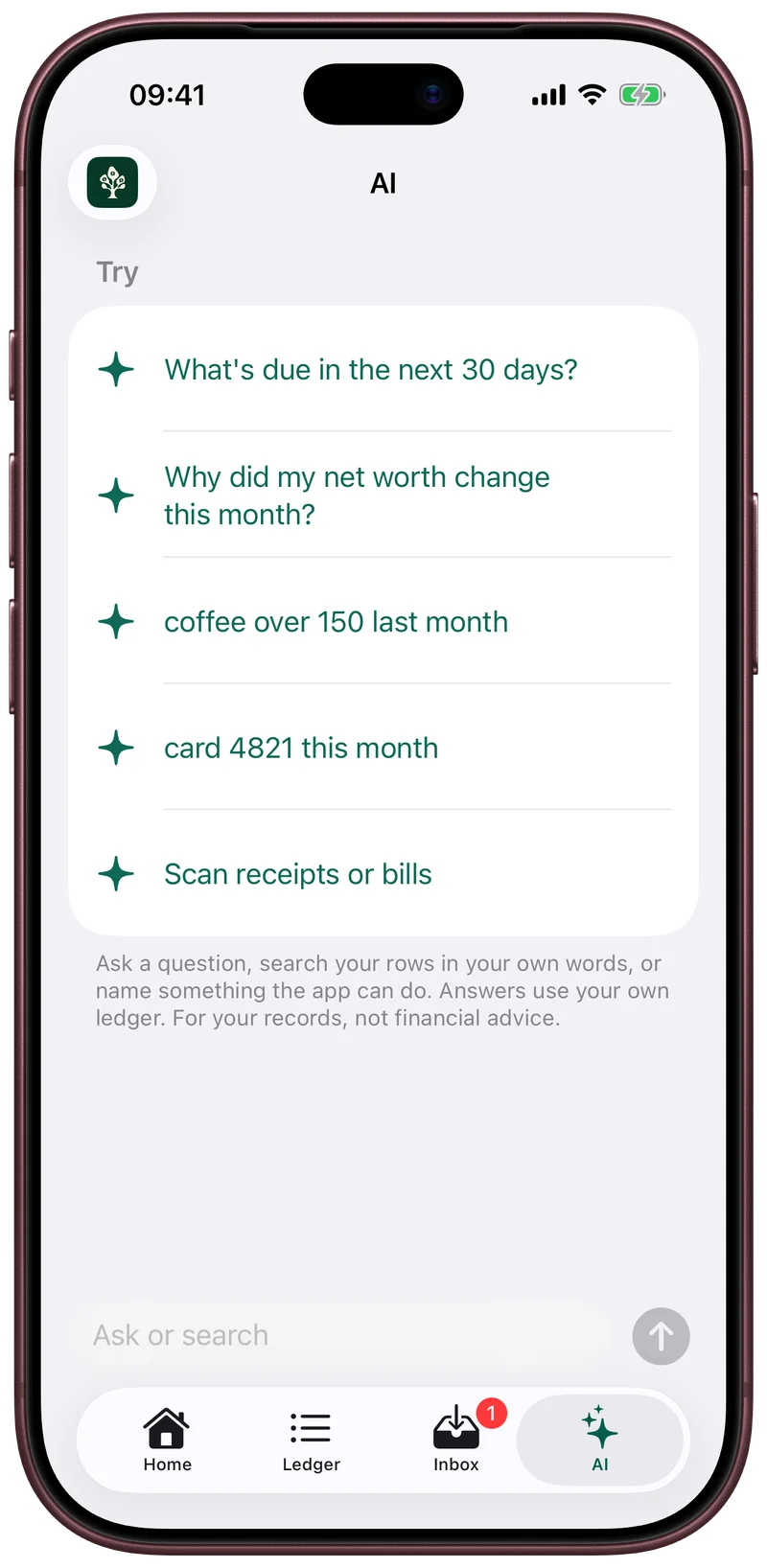
Fullgrove files each row into a category as it arrives from a statement, receipt or typed line, so you can see what you really spent on needs and wants. Ask the assistant “how much did we spend on food this month?” and every number in the answer is computed from your own ledger.
Apply the 50/30/20 rule
- Find your monthly take-home pay.
- Multiply it by 0.5 for needs, 0.3 for wants and 0.2 for savings.
- Sort last month's spending into needs and wants.
- Compare your real split with the targets and choose one category to adjust.