
Asset allocation, step by step
Updated
Asset allocation is the share of your money in each kind of asset: stocks, bonds and other debt assets, cash, and property. Add up what you hold in each, divide by the total to get your current mix, choose a target mix that fits your time horizon and tolerance for swings, and review the gap once or twice a year. This page explains the method and gives no investment advice.
The main asset classes
- Stocks: the highest long-term growth and the largest swings.
- Bonds and other debt assets: steadier income, smaller swings.
- Cash: stable value, and the place for an emergency fund.
- Real estate: your home or other property; valuable but hard to sell in part.
Calculate your current mix
| Asset class | Value | Share |
|---|---|---|
| Cash | $20,000 | 10% |
| Stocks and stock funds | $90,000 | 45% |
| Bonds | $30,000 | 15% |
| Real estate | $60,000 | 30% |
| Total | $200,000 | 100% |
Example figures show the method only.
Rules of thumb and their limits
You will often see “hold 110 minus your age in stocks” or target-date funds that shift from stocks to bonds as a date approaches. They are simple starting points. They do not know your income, other assets, debts or plans, so treat them as questions to think through.
Should your home count
Your home belongs in net worth. Many people leave it out of the investment mix, because you cannot sell a slice of it to rebalance. If you include it, expect real estate to dominate the mix for years.
Rebalancing
- By calendar: check once or twice a year and move back toward the target.
- By threshold: act when a class drifts more than a set amount, such as five percentage points.
- With new money: direct new savings to the class below target, which avoids selling.
See your mix in Fullgrove
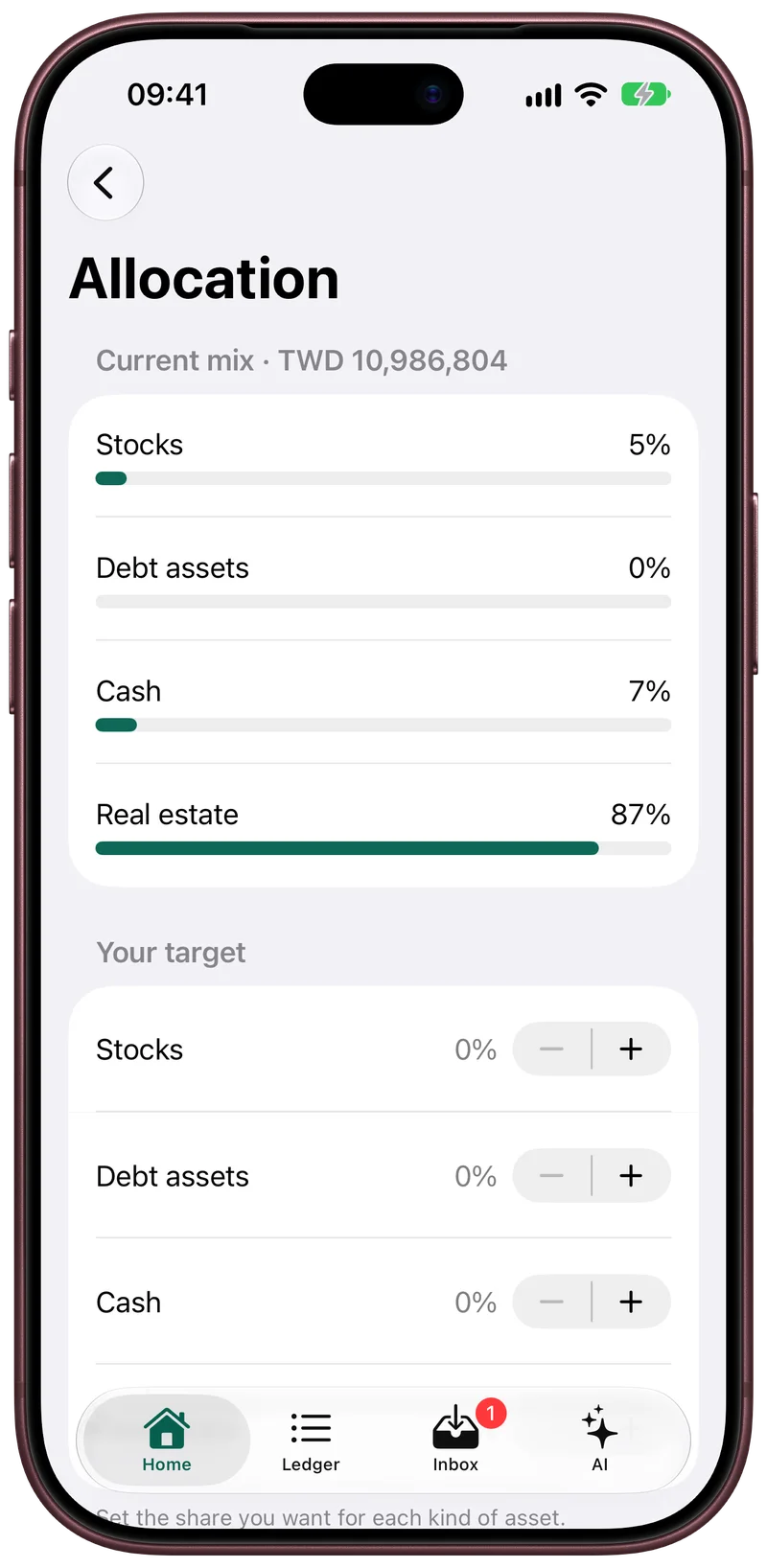
Allocation shows your current mix and total across every account and currency. You set the share you want for each kind of asset, and Fullgrove shows how far each one is above or below your target in money. It also shows a range of possible yearly returns from the return and volatility you enter. Those are calculations from your assumptions; they are not forecasts, and Fullgrove gives no investment advice.
Work out your asset allocation
- List every account and holding with today's value.
- Group each one as stocks, bonds and other debt assets, cash, or real estate.
- Divide each group's total by the overall total to get your current mix.
- Write down a target mix and the gap for each class, and review it once or twice a year.